
Bulk SMS marketing helps businesses reach customers directly on their mobile phones. It can support sales campaigns, share time-sensitive offers, remind customers about appointments or payments, and bring previous buyers back to a business.
But sending messages in bulk is not a sales strategy by itself. Results depend on the audience, timing, offer, message quality, landing page and follow-up process. When these parts work together, SMS can become a useful channel for generating enquiries, encouraging purchases and improving customer retention.
In this guide, we’ll look at seven practical ways to use bulk SMS marketing, examples of messages you can adapt, and the metrics to track over the first 60 days.
Why Use Bulk SMS Marketing for Sales?
SMS is useful when a message needs to reach a customer quickly and clearly. Unlike social media posts, an SMS campaign does not depend on a customer opening a social platform and seeing your post in their feed. It can also complement email, paid advertising and WhatsApp communication.
Businesses commonly use SMS for:
- Promoting a limited-time offer to an opted-in customer list.
- Sharing order, booking and payment updates.
- Reminding customers about appointments or renewals.
- Following up with leads who have requested information.
- Inviting existing customers to return for another purchase.
If you are comparing service options, explore the Bulk SMS service offered by My Dreams Technology.
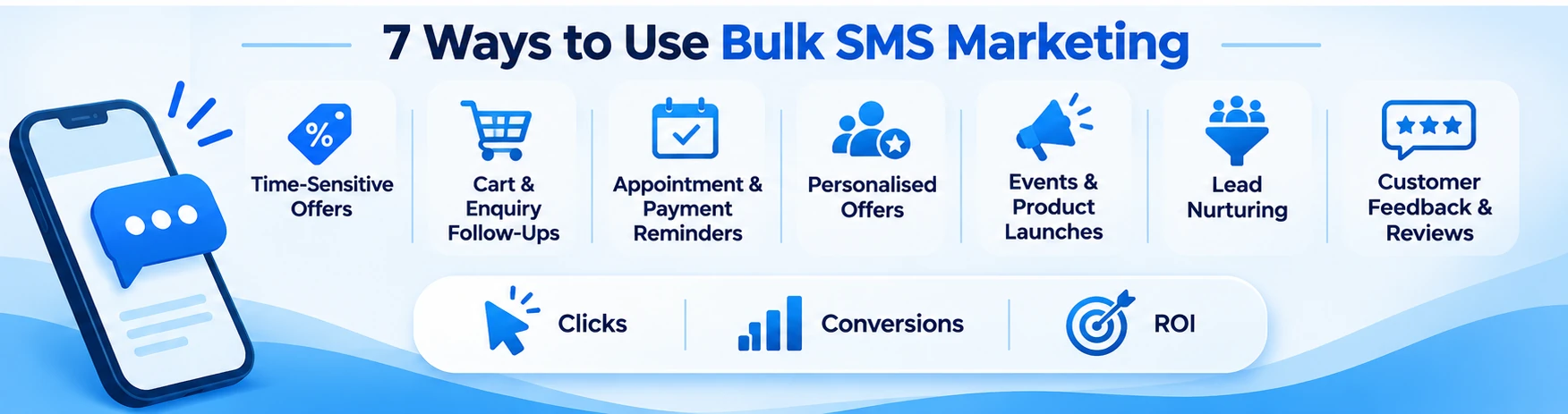
1. Run Time-Sensitive Promotional Campaigns
A relevant offer with a clear deadline can encourage customers to act sooner. Use flash-sale SMS campaigns for product launches, seasonal promotions, weekend offers or clearance sales. Keep the message specific and make the next step easy.
Example SMS: “Weekend offer: Get 15% off selected products until Sunday. View the offer: [short link]. Reply STOP to opt out.”
What to measure: delivered messages, link clicks, orders or enquiries generated, and revenue attributed to the campaign.
For campaigns focused on discounts and announcements, see Promotional SMS services.
2. Follow Up on Abandoned Carts and Incomplete Enquiries
Some customers add products to a cart or submit an enquiry but do not complete the next step. A timely reminder can bring them back. This works best when your website or CRM can identify the incomplete action and trigger a relevant message.
Example SMS: “Hi [Name], your cart is still waiting. Complete your order here: [link]. Need help? Contact our team.”
Do not send cart reminders to people who have not agreed to receive marketing messages. Make sure your tracking, consent records and messaging setup support this use case.
What to measure: recovered carts, completed purchases, conversion rate and revenue from the reminder sequence.
3. Send Appointment and Payment Reminders
Missed appointments and delayed payments can affect cash flow, especially for clinics, salons, education providers, service businesses and consultants. Transactional SMS reminders help customers remember important dates and actions.
Appointment example: “Reminder: Your appointment is scheduled for [date] at [time]. Call [number] if you need to reschedule.”
Payment example: “Your payment of ₹[amount] is due on [date]. Please use [secure payment link] or contact us for assistance.”
Keep transactional messages factual and relevant. Avoid including sensitive personal or financial information in a text message.
For alerts, confirmations and service updates, learn more about Transactional SMS.
4. Send Personalised Offers to Encourage Repeat Purchases
Existing customers already know your business. A relevant follow-up offer can encourage them to buy again, renew a service or explore a related product. Segment your list by purchase history, interests, location or customer lifecycle instead of sending the same offer to everyone.
Example SMS: “Hi [Name], it may be time to restock [product]. Enjoy [offer] until [date]. Shop here: [link].”
Personalisation should be useful, not intrusive. Use customer information only when you have the appropriate permission and a clear business reason.
What to measure: repeat purchase rate, redemption rate, average order value and revenue per campaign.
5. Promote Store Events, Product Launches and Local Offers
SMS can help businesses invite nearby customers to a store opening, product demonstration, seasonal event or special in-store offer. Include the event date, location and one clear action. If possible, link to a page with directions or registration details.
Example SMS: “New store opening this Saturday at [location]. Visit us between [time] and [time] for launch offers. Directions: [link].”
Send event messages to a relevant audience and avoid excessive reminders. Track registrations, coupon redemptions, visits or enquiries to understand the campaign’s impact.
6. Nurture Leads with a Short SMS Follow-Up Sequence
Not every prospect is ready to buy after the first interaction. A short, helpful sequence can answer common questions and guide interested leads towards the next step. Build the sequence around the action the prospect has taken, such as requesting a quote, downloading a brochure or booking a demo.
A simple sequence could look like this:
- Immediately: confirm the enquiry and explain when the team will respond.
- After one or two days: share a useful resource or answer a common question.
- After a few more days: invite the prospect to book a call, request a quote or view a relevant product.
Example SMS: “Thanks for enquiring about [product/service], [Name]. You can review the details here: [link]. Reply to this message if you would like our team to call you.”
Use a sensible frequency and stop the sequence when the person responds, converts or opts out. Measure replies, qualified leads, booked calls and sales opportunities.
7. Request Customer Feedback and Reviews
A follow-up message after a completed purchase or service can help you understand the customer experience. Invite customers to share honest feedback through a simple survey or review link.
Example SMS: “Thank you for choosing [Business Name]. We would value your feedback about your recent experience: [review link].”
Do not offer rewards only for positive reviews or pressure customers to leave a favourable rating. Ask for honest feedback and follow the review platform’s policies.
What to measure: feedback response rate, review volume, recurring issues and improvements in customer satisfaction.
How to Measure Bulk SMS Marketing ROI
Do not judge a campaign only by the number of messages sent or delivered. Connect campaign activity to clicks, enquiries, purchases and revenue wherever possible.
Basic ROI formula: ((Revenue attributed to the campaign − Campaign cost) ÷ Campaign cost) × 100
Example:
- Campaign cost: ₹5,000
- Revenue attributed to the campaign: ₹25,000
- ROI: ((₹25,000 − ₹5,000) ÷ ₹5,000) × 100 = 400%
This example assumes the ₹25,000 in revenue can reasonably be attributed to the SMS campaign. Use tracked links, unique coupon codes, CRM records or a clear attribution method. Include message charges, platform fees, creative costs and any other campaign expenses in the cost calculation.
Track these metrics together:
- Delivery rate: delivered messages divided by submitted messages.
- Click-through rate: unique link clicks divided by delivered messages.
- Conversion rate: purchases or qualified actions divided by delivered messages or clicks, depending on your reporting method.
- Cost per conversion: total campaign cost divided by conversions.
- Revenue and ROI: revenue attributed to the campaign compared with total campaign cost.
How to Launch a Bulk SMS Campaign: A Practical Checklist
- Set one clear objective: sales, enquiries, attendance, payment collection or retention.
- Build a relevant contact segment and confirm that recipients have the required consent.
- Prepare the message, sender details, approved template and destination link.
- Check applicable TRAI/DLT requirements before sending commercial SMS in India.
- Test the message, links and landing page on mobile devices.
- Schedule the campaign at a time that suits the audience and message type.
- Review delivery reports, clicks, replies and conversions after sending.
- Use the findings to improve the next campaign.
A reliable platform should make it easier to manage campaigns, review delivery reports and get support when needed. Compare features and costs before selecting a provider.
You can review the available Bulk SMS plans and pricing before choosing a package.
What Can You Achieve in 60 Days?
A 60-day period is a useful testing window, not a guaranteed sales deadline. Use the first two months to build a baseline, test different audience segments and offers, and identify which messages lead to meaningful actions.
- Days 1–15: define the goal, prepare consent-based contact segments, confirm templates and launch a small test.
- Days 16–30: review delivery, clicks, replies and conversions. Improve the message and landing page.
- Days 31–45: test a second offer or audience segment. Add relevant follow-ups where appropriate.
- Days 46–60: compare campaign results, calculate cost per conversion and decide what to scale.
The outcome will vary by industry, audience quality, offer, pricing, website experience and follow-up process. Focus on measurable improvement rather than assuming every campaign will generate the same return.
Frequently Asked Questions
Is bulk SMS marketing effective for small businesses?
It can be useful for small businesses that have a relevant, permission-based customer list and a clear message. Start with a small campaign and measure enquiries, purchases or repeat visits.
What is the best type of SMS for increasing sales?
Promotional SMS is commonly used for offers, launches and sales campaigns. Transactional SMS is better suited to confirmations, reminders and service updates. Choose the message type based on its purpose and applicable rules.
How quickly can an SMS campaign generate results?
Some customers may respond soon after receiving a relevant message, but results vary. Measure performance across multiple campaigns instead of treating a single send as a guarantee.
How do I calculate SMS marketing ROI?
Subtract campaign cost from the revenue attributed to the campaign, divide the result by campaign cost and multiply by 100. Use a clear attribution method and include all campaign expenses.
Do businesses need a bulk SMS service provider?
A bulk SMS provider can offer campaign tools, delivery reports, integrations and support. Compare compliance assistance, route quality, reporting, pricing and technical support before choosing one.
What should I check before sending bulk SMS in India?
Check the applicable TRAI and DLT requirements, including sender/header and template processes, consent and message category. Confirm current requirements with your provider and the relevant telecom operator guidance.
Ready to Plan Your Next SMS Campaign?
The right SMS campaign starts with a relevant audience, a useful message and a measurable goal. Whether you want to promote an offer, send customer reminders or follow up with leads, choose a campaign approach that fits your business objective.
Explore My Dreams Technology’s Bulk SMS service to review the available features.
For package details, visit the pricing page, or contact the team to discuss your requirements.